organic compound
English Thesaurus
1. any compound of carbon and another element or a radical (noun.substance)
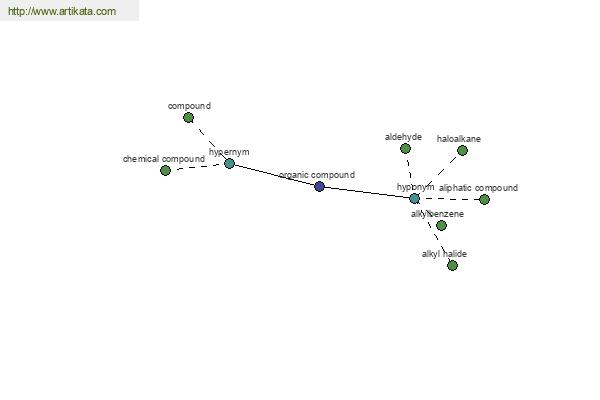
| hypernym | : | chemical compound, compound, |
| definition | : | (chemistry) a substance formed by chemical union of two or more elements or ingredients in definite proportion by weight (noun.substance) |
| hyponym | : | aldehyde, |
| definition | : | any of a class of highly reactive chemical compounds; used in making resins and dyes and organic acids (noun.substance) |
| hyponym | : | aliphatic compound, |
| definition | : | organic compound that is an alkane or alkene or alkyne or their derivative (noun.substance) |
| hyponym | : | alkylbenzene, |
| definition | : | organic compound that has an alkyl group bound to a benzene ring (noun.substance) |
| hyponym | : | alkyl halide, haloalkane, |
| definition | : | organic compound in which halogen atoms have been substituted for hydrogen atoms in an alkane (noun.substance) |
| hyponym | : | diamine, |
| definition | : | any organic compound containing two amino groups (noun.substance) |
| hyponym | : | enol, |
| definition | : | an organic compound that contains a hydroxyl group bonded to a carbon atom which in turn is doubly bonded to another carbon atom (noun.substance) |
| hyponym | : | halon, |
| definition | : | a compound in which the hydrogen atoms of a hydrocarbon have been replaced by bromine and other halogen atoms; very stable; used in fire extinguishers although it is thought to release bromine that depletes the ozone layer (noun.substance) |
| hyponym | : | peptone, |
| definition | : | any of various water-soluble compounds that form by hydrolysis in the digestion of proteins to amino acids (noun.substance) |
| hyponym | : | quaternary ammonium compound, |
| definition | : | a compound derived from ammonium with hydrogen atoms replaced by organic groups; used as surface-active agents, disinfectants, and in drugs (noun.substance) |
| hyponym | : | proenzyme, zymogen, |
| definition | : | any of a group of compounds that are inactive precursors of enzymes and require some change (such as the hydrolysis of a fragment that masks an active enzyme) to become active (noun.substance) |
| hyponym | : | propylthiouracil, |
| definition | : | a crystalline compound used as an antithyroid drug in the treatment of goiter (noun.substance) |
| hyponym | : | ether, |
| definition | : | any of a class of organic compounds that have two hydrocarbon groups linked by an oxygen atom (noun.substance) |
| hyponym | : | acetal, |
| definition | : | any organic compound formed by adding alcohol molecules to aldehyde molecules (noun.substance) |
| hyponym | : | aldehyde-alcohol, aldol, |
| definition | : | an oily colorless liquid obtained by the condensation of two molecules of acetaldehyde; contains an alcohol group (-OH) and an aldehyde group (-CHO) (noun.substance) |
| hyponym | : | alkaloid, |
| definition | : | natural bases containing nitrogen found in plants (noun.substance) |
| hyponym | : | amide, |
| definition | : | any organic compound containing the group -CONH2 (noun.substance) |
| hyponym | : | rennet, |
| definition | : | a substance that curdles milk in making cheese and junket (noun.substance) |
| hyponym | : | azadirachtin, |
| definition | : | insecticide (noun.substance) |
| hyponym | : | thiazine, |
| definition | : | a compound made up of a ring of four carbon atoms and one sulfur atom and one nitrogen atom (noun.substance) |
| hyponym | : | cacodyl, tetramethyldiarsine, |
| definition | : | a poisonous oily liquid with a garlicky odor composed of 2 cacodyl groups; undergoes spontaneous combustion in dry air (noun.substance) |
| hyponym | : | neurochemical, |
| definition | : | any organic substance that occurs in neural activity (noun.substance) |
| hyponym | : | acid halide, acyl halide, |
| definition | : | organic compounds containing the group -COX where X is a halogen atom (noun.substance) |
| hyponym | : | coal-tar creosote, creosote, |
| definition | : | a dark oily liquid obtained by distillation of coal tar; used as a preservative for wood (noun.substance) |
| hyponym | : | creosote, |
| definition | : | a colorless or yellowish oily liquid obtained by distillation of wood tar; used as an antiseptic (noun.substance) |
| hyponym | : | cyanide, nitril, nitrile, |
| definition | : | any of a class of organic compounds containing the cyano radical -CN (noun.substance) |
| hyponym | : | cyanohydrin, |
| definition | : | any organic compound in which the cyano radical -CN and the hydroxyl radical -OH are attached to the same carbon atom (noun.substance) |
| hyponym | : | ester, |
| definition | : | formed by reaction between an acid and an alcohol with elimination of water (noun.substance) |
| hyponym | : | furan, furane, furfuran, |
| definition | : | a colorless toxic flammable liquid used in the synthesis of nylon (noun.substance) |
| hyponym | : | glycoside, |
| definition | : | a group of compounds derived from monosaccharides (noun.substance) |
| hyponym | : | resin, rosin, |
| definition | : | any of a class of solid or semisolid viscous substances obtained either as exudations from certain plants or prepared by polymerization of simple molecules (noun.substance) |
| hyponym | : | halocarbon, |
| definition | : | one of various compounds of carbon and any of the halogens (noun.substance) |
| hyponym | : | hemiacetal, |
| definition | : | an organic compound usually formed as an intermediate product in the preparation of acetals from aldehydes or ketones (noun.substance) |
| hyponym | : | humic substance, |
| definition | : | an organic residue of decaying organic matter (noun.substance) |
| hyponym | : | hydrocarbon, |
| definition | : | an organic compound containing only carbon and hydrogen (noun.substance) |
| hyponym | : | ketone, |
| definition | : | any of a class of organic compounds having a carbonyl group linked to a carbon atom in each of two hydrocarbon radicals (noun.substance) |
| hyponym | : | macromolecule, supermolecule, |
| definition | : | any very large complex molecule; found only in plants and animals (noun.substance) |
| hyponym | : | nitrobenzene, |
| definition | : | a poisonous oily water-soluble liquid used as a solvent and in the manufacture of aniline (noun.substance) |
| hyponym | : | oxime, |
| definition | : | any compound containing the group -C=NOH (noun.substance) |
| hyponym | : | petrochemical, |
| definition | : | any compound obtained from petroleum or natural gas (noun.substance) |
| hyponym | : | phenol, |
| definition | : | any of a class of weakly acidic organic compounds; molecule contains one or more hydroxyl groups (noun.substance) |
| hyponym | : | pyrimidine, |
| definition | : | a heterocyclic organic compound with a penetrating odor (noun.substance) |
| hyponym | : | quassia, |
| definition | : | a bitter compound used as an insecticide and tonic and vermifuge; extracted from the wood and bark of trees of the genera Quassia and Picrasma (noun.substance) |
| hyponym | : | steroid, |
| definition | : | any of several fat-soluble organic compounds having as a basis 17 carbon atoms in four rings; many have important physiological effects (noun.substance) |
| hyponym | : | nonsteroid, nonsteroidal, |
| definition | : | an organic compound that does no contain a steroid (noun.substance) |
| hyponym | : | thiouracil, |
| definition | : | depresses the function of the thyroid gland (noun.substance) |
| hyponym | : | carbamide, urea, |
| definition | : | the chief solid component of mammalian urine; synthesized from ammonia and carbon dioxide and used as fertilizer and in animal feed and in plastics (noun.substance) |
| hyponym | : | imide, |
| definition | : | any of a class of organic compounds that contain the divalent radical -CONHCO- (noun.substance) |
| hyponym | : | xanthine, |
| definition | : | crystalline oxidation product of the metabolism of nucleoproteins; precursor of uric acid; found in many organs and in urine (noun.substance) |
Visual ArtiKata
 Explore organic compound in ArtiKata.com >