metallic element
English Thesaurus
1. any of several chemical elements that are usually shiny solids that conduct heat or electricity and can be formed into sheets etc. (noun.substance)
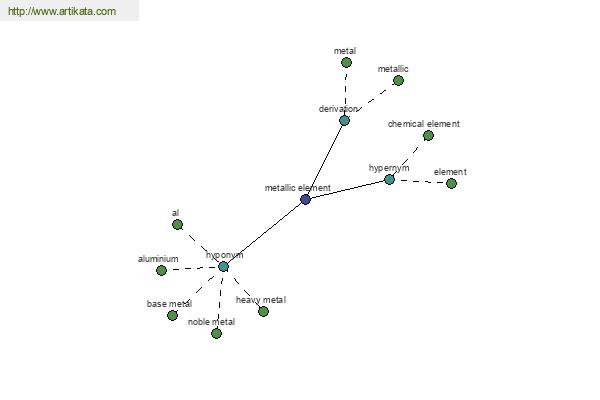
| hypernym | : | chemical element, element, |
| definition | : | any of the more than 100 known substances (of which 92 occur naturally) that cannot be separated into simpler substances and that singly or in combination constitute all matter (noun.substance) |
| hyponym | : | heavy metal, |
| definition | : | a metal of relatively high density (specific gravity greater than about 5) or of high relative atomic weight (especially one that is poisonous like mercury or lead) (noun.substance) |
| hyponym | : | base metal, |
| definition | : | a metal that is common and not considered precious (noun.substance) |
| hyponym | : | noble metal, |
| definition | : | any metal that is resistant to corrosion or oxidation (noun.substance) |
| hyponym | : | am, americium, atomic number 95, |
| definition | : | a radioactive transuranic metallic element; discovered by bombarding uranium with helium atoms (noun.substance) |
| hyponym | : | antimony, atomic number 51, sb, |
| definition | : | a metallic element having four allotropic forms; used in a wide variety of alloys; found in stibnite (noun.substance) |
| hyponym | : | atomic number 56, ba, barium, |
| definition | : | a soft silvery metallic element of the alkali earth group; found in barite (noun.substance) |
| hyponym | : | atomic number 97, berkelium, bk, |
| definition | : | a radioactive transuranic element; discovered by bombarding americium with helium (noun.substance) |
| hyponym | : | atomic number 83, bi, bismuth, |
| definition | : | a heavy brittle diamagnetic trivalent metallic element (resembles arsenic and antimony chemically); usually recovered as a by-product from ores of other metals (noun.substance) |
| hyponym | : | atomic number 48, cadmium, cd, |
| definition | : | a soft bluish-white ductile malleable toxic bivalent metallic element; occurs in association with zinc ores (noun.substance) |
| hyponym | : | atomic number 20, ca, calcium, |
| definition | : | a white metallic element that burns with a brilliant light; the fifth most abundant element in the earth's crust; an important component of most plants and animals (noun.substance) |
| hyponym | : | atomic number 98, californium, cf, |
| definition | : | a radioactive transuranic element; discovered by bombarding curium with alpha particles (noun.substance) |
| hyponym | : | atomic number 58, ce, cerium, |
| definition | : | a ductile grey metallic element of the lanthanide series; used in lighter flints; the most abundant of the rare-earth group (noun.substance) |
| hyponym | : | atomic number 55, caesium, cesium, cs, |
| definition | : | a soft silver-white ductile metallic element (liquid at normal temperatures); the most electropositive and alkaline metal (noun.substance) |
| hyponym | : | atomic number 24, chromium, cr, |
| definition | : | a hard brittle multivalent metallic element; resistant to corrosion and tarnishing (noun.substance) |
| hyponym | : | atomic number 27, co, cobalt, |
| definition | : | a hard ferromagnetic silver-white bivalent or trivalent metallic element; a trace element in plant and animal nutrition (noun.substance) |
| hyponym | : | atomic number 29, copper, cu, |
| definition | : | a ductile malleable reddish-brown corrosion-resistant diamagnetic metallic element; occurs in various minerals but is the only metal that occurs abundantly in large masses; used as an electrical and thermal conductor (noun.substance) |
| hyponym | : | atomic number 96, cm, curium, |
| definition | : | a radioactive transuranic metallic element; produced by bombarding plutonium with helium nuclei (noun.substance) |
| hyponym | : | atomic number 66, dy, dysprosium, |
| definition | : | a trivalent metallic element of the rare earth group; forms compounds that are highly magnetic (noun.substance) |
| hyponym | : | atomic number 99, e, einsteinium, es, |
| definition | : | a radioactive transuranic element produced by bombarding plutonium with neutrons (noun.substance) |
| hyponym | : | atomic number 68, er, erbium, |
| definition | : | a trivalent metallic element of the rare earth group; occurs with yttrium (noun.substance) |
| hyponym | : | atomic number 63, eu, europium, |
| definition | : | a bivalent and trivalent metallic element of the rare earth group (noun.substance) |
| hyponym | : | atomic number 100, fermium, fm, |
| definition | : | a radioactive transuranic metallic element produced by bombarding plutonium with neutrons (noun.substance) |
| hyponym | : | atomic number 87, fr, francium, |
| definition | : | a radioactive element of the alkali-metal group discovered as a disintegration product of actinium (noun.substance) |
| hyponym | : | atomic number 64, gadolinium, gd, |
| definition | : | a ductile silvery-white ductile ferromagnetic trivalent metallic element of the rare earth group (noun.substance) |
| hyponym | : | atomic number 31, ga, gallium, |
| definition | : | a rare silvery (usually trivalent) metallic element; brittle at low temperatures but liquid above room temperature; occurs in trace amounts in bauxite and zinc ores (noun.substance) |
| hyponym | : | atomic number 72, hafnium, hf, |
| definition | : | a grey tetravalent metallic element that resembles zirconium chemically and is found in zirconium minerals; used in filaments for its ready emission of electrons (noun.substance) |
| hyponym | : | atomic number 67, ho, holmium, |
| definition | : | a trivalent metallic element of the rare earth group; occurs together with yttrium; forms highly magnetic compounds (noun.substance) |
| hyponym | : | atomic number 49, in, indium, |
| definition | : | a rare soft silvery metallic element; occurs in small quantities in sphalerite (noun.substance) |
| hyponym | : | atomic number 77, ir, iridium, |
| definition | : | a heavy brittle metallic element of the platinum group; used in alloys; occurs in natural alloys with platinum or osmium (noun.substance) |
| hyponym | : | atomic number 26, fe, iron, |
| definition | : | a heavy ductile magnetic metallic element; is silver-white in pure form but readily rusts; used in construction and tools and armament; plays a role in the transport of oxygen by the blood (noun.substance) |
| hyponym | : | atomic number 57, la, lanthanum, |
| definition | : | a white soft metallic element that tarnishes readily; occurs in rare earth minerals and is usually classified as a rare earth (noun.substance) |
| hyponym | : | atomic number 82, lead, pb, |
| definition | : | a soft heavy toxic malleable metallic element; bluish white when freshly cut but tarnishes readily to dull grey (noun.substance) |
| hyponym | : | atomic number 3, li, lithium, |
| definition | : | a soft silver-white univalent element of the alkali metal group; the lightest metal known; occurs in several minerals (noun.substance) |
| hyponym | : | atomic number 71, lu, lutecium, lutetium, |
| definition | : | a trivalent metallic element of the rare earth group; usually occurs in association with yttrium (noun.substance) |
| hyponym | : | atomic number 12, magnesium, mg, |
| definition | : | a light silver-white ductile bivalent metallic element; in pure form it burns with brilliant white flame; occurs naturally only in combination (as in magnesite and dolomite and carnallite and spinel and olivine) (noun.substance) |
| hyponym | : | atomic number 25, manganese, mn, |
| definition | : | a hard brittle grey polyvalent metallic element that resembles iron but is not magnetic; used in making steel; occurs in many minerals (noun.substance) |
| hyponym | : | atomic number 42, mo, molybdenum, |
| definition | : | a polyvalent metallic element that resembles chromium and tungsten in its properties; used to strengthen and harden steel (noun.substance) |
| hyponym | : | atomic number 60, nd, neodymium, |
| definition | : | a yellow trivalent metallic element of the rare earth group; occurs in monazite and bastnasite in association with cerium and lanthanum and praseodymium (noun.substance) |
| hyponym | : | atomic number 93, neptunium, np, |
| definition | : | a radioactive transuranic metallic element; found in trace amounts in uranium ores; a by-product of the production of plutonium (noun.substance) |
| hyponym | : | atomic number 28, ni, nickel, |
| definition | : | a hard malleable ductile silvery metallic element that is resistant to corrosion; used in alloys; occurs in pentlandite and smaltite and garnierite and millerite (noun.substance) |
| hyponym | : | atomic number 41, nb, niobium, |
| definition | : | a soft grey ductile metallic element used in alloys; occurs in niobite; formerly called columbium (noun.substance) |
| hyponym | : | atomic number 76, os, osmium, |
| definition | : | a hard brittle blue-grey or blue-black metallic element that is one of the platinum metals; the heaviest metal known (noun.substance) |
| hyponym | : | atomic number 46, palladium, pd, |
| definition | : | a silver-white metallic element of the platinum group that resembles platinum; occurs in some copper and nickel ores; does not tarnish at ordinary temperatures and is used (alloyed with gold) in jewelry (noun.substance) |
| hyponym | : | atomic number 84, po, polonium, |
| definition | : | a radioactive metallic element that is similar to tellurium and bismuth; occurs in uranium ores but can be produced by bombarding bismuth with neutrons in a nuclear reactor (noun.substance) |
| hyponym | : | atomic number 19, k, potassium, |
| definition | : | a light soft silver-white metallic element of the alkali metal group; oxidizes rapidly in air and reacts violently with water; is abundant in nature in combined forms occurring in sea water and in carnallite and kainite and sylvite (noun.substance) |
| hyponym | : | atomic number 59, pr, praseodymium, |
| definition | : | a soft yellowish-white trivalent metallic element of the rare earth group; can be recovered from bastnasite or monazite by an ion-exchange process (noun.substance) |
| hyponym | : | atomic number 61, pm, promethium, |
| definition | : | a soft silvery metallic element of the rare earth group having no stable isotope; was discovered in radioactive form as a fission product of uranium (noun.substance) |
| hyponym | : | atomic number 88, ra, radium, |
| definition | : | an intensely radioactive metallic element that occurs in minute amounts in uranium ores (noun.substance) |
| hyponym | : | atomic number 75, re, rhenium, |
| definition | : | a rare heavy polyvalent metallic element that resembles manganese chemically and is used in some alloys; is obtained as a by-product in refining molybdenum (noun.substance) |
| hyponym | : | atomic number 45, rh, rhodium, |
| definition | : | a white hard metallic element that is one of the platinum group and is found in platinum ores; used in alloys with platinum (noun.substance) |
| hyponym | : | atomic number 37, rb, rubidium, |
| definition | : | a soft silvery metallic element of the alkali metal group; burns in air and reacts violently in water; occurs in carnallite and lepidolite and pollucite (noun.substance) |
| hyponym | : | atomic number 44, ru, ruthenium, |
| definition | : | a rare polyvalent metallic element of the platinum group; it is found associated with platinum (noun.substance) |
| hyponym | : | atomic number 62, samarium, sm, |
| definition | : | a grey lustrous metallic element of the rare earth group; is used in special alloys; occurs in monazite and bastnasite (noun.substance) |
| hyponym | : | atomic number 21, sc, scandium, |
| definition | : | a white trivalent metallic element; sometimes classified in the rare earth group; occurs in the Scandinavian mineral thortveitite (noun.substance) |
| hyponym | : | atomic number 11, na, sodium, |
| definition | : | a silvery soft waxy metallic element of the alkali metal group; occurs abundantly in natural compounds (especially in salt water); burns with a yellow flame and reacts violently in water; occurs in sea water and in the mineral halite (rock salt) (noun.substance) |
| hyponym | : | atomic number 38, sr, strontium, |
| definition | : | a soft silver-white or yellowish metallic element of the alkali metal group; turns yellow in air; occurs in celestite and strontianite (noun.substance) |
| hyponym | : | atomic number 73, ta, tantalum, |
| definition | : | a hard grey lustrous metallic element that is highly resistant to corrosion; occurs in niobite and fergusonite and tantalite (noun.substance) |
| hyponym | : | atomic number 43, tc, technetium, |
| definition | : | a crystalline metallic element not found in nature; occurs as one of the fission products of uranium (noun.substance) |
| hyponym | : | atomic number 65, tb, terbium, |
| definition | : | a metallic element of the rare earth group; used in lasers; occurs in apatite and monazite and xenotime and ytterbite (noun.substance) |
| hyponym | : | atomic number 81, thallium, tl, |
| definition | : | a soft grey malleable metallic element that resembles tin but discolors on exposure to air; it is highly toxic and is used in rodent and insect poisons; occurs in zinc blende and some iron ores (noun.substance) |
| hyponym | : | atomic number 90, th, thorium, |
| definition | : | a soft silvery-white tetravalent radioactive metallic element; isotope 232 is used as a power source in nuclear reactors; occurs in thorite and in monazite sands (noun.substance) |
| hyponym | : | atomic number 69, thulium, tm, |
| definition | : | a soft silvery metallic element of the rare earth group; isotope 170 emits X-rays and is used in small portable X-ray machines; it occurs in monazite and apatite and xenotime (noun.substance) |
| hyponym | : | atomic number 50, sn, tin, |
| definition | : | a silvery malleable metallic element that resists corrosion; used in many alloys and to coat other metals to prevent corrosion; obtained chiefly from cassiterite where it occurs as tin oxide (noun.substance) |
| hyponym | : | atomic number 22, ti, titanium, |
| definition | : | a light strong grey lustrous corrosion-resistant metallic element used in strong lightweight alloys (as for airplane parts); the main sources are rutile and ilmenite (noun.substance) |
| hyponym | : | atomic number 74, tungsten, w, wolfram, |
| definition | : | a heavy grey-white metallic element; the pure form is used mainly in electrical applications; it is found in several ores including wolframite and scheelite (noun.substance) |
| hyponym | : | atomic number 92, u, uranium, |
| definition | : | a heavy toxic silvery-white radioactive metallic element; occurs in many isotopes; used for nuclear fuels and nuclear weapons (noun.substance) |
| hyponym | : | atomic number 23, v, vanadium, |
| definition | : | a soft silvery white toxic metallic element used in steel alloys; it occurs in several complex minerals including carnotite and vanadinite (noun.substance) |
| hyponym | : | atomic number 70, yb, ytterbium, |
| definition | : | a soft silvery metallic element; a rare earth of the lanthanide series; it occurs in gadolinite and monazite and xenotime (noun.substance) |
| hyponym | : | atomic number 39, y, yttrium, |
| definition | : | a silvery metallic element that is common in rare-earth minerals; used in magnesium and aluminum alloys (noun.substance) |
| hyponym | : | atomic number 30, zinc, zn, |
| definition | : | a bluish-white lustrous metallic element; brittle at ordinary temperatures but malleable when heated; used in a wide variety of alloys and in galvanizing iron; it occurs naturally as zinc sulphide in zinc blende (noun.substance) |
| hyponym | : | atomic number 40, zirconium, zr, |
| definition | : | a lustrous grey strong metallic element resembling titanium; it is used in nuclear reactors as a neutron absorber; it occurs in baddeleyite but is obtained chiefly from zircon (noun.substance) |
| hyponym | : | alkali metal, alkaline metal, |
| definition | : | any of the monovalent metals of group I of the periodic table (lithium or sodium or potassium or rubidium or cesium or francium) (noun.substance) |
| hyponym | : | alkaline earth, alkaline-earth metal, |
| definition | : | any of the bivalent metals of group II of the periodic table (calcium or strontium or barium or magnesium or beryllium) (noun.substance) |
| derivation | : | metal, |
| definition | : | cover with metal (verb.contact) |
| derivation | : | metal, metallic, |
| definition | : | containing or made of or resembling or characteristic of a metal (adj.all) |
| derivation | : | metal, |
| definition | : | cover with metal (verb.contact) |
| derivation | : | metal, metallic, |
| definition | : | containing or made of or resembling or characteristic of a metal (adj.all) |
Visual ArtiKata
 Explore metallic element in ArtiKata.com >