eubacteria
English Thesaurus
1. a large group of bacteria having rigid cell walls; motile types have flagella (noun.animal)
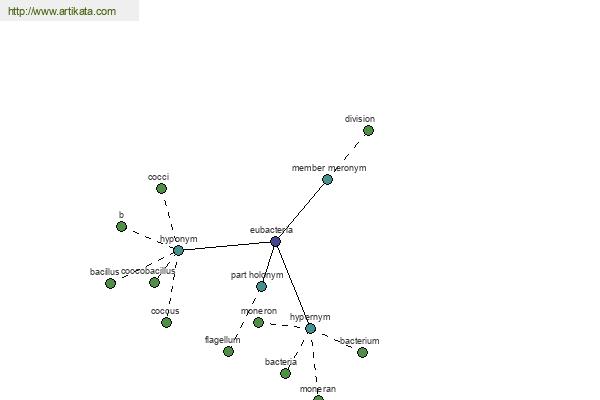
| hypernym | : | moneran, moneron, |
| definition | : | organisms that typically reproduce by asexual budding or fission and whose nutritional mode is absorption or photosynthesis or chemosynthesis (noun.animal) |
| hypernym | : | bacteria, bacterium, |
| definition | : | (microbiology) single-celled or noncellular spherical or spiral or rod-shaped organisms lacking chlorophyll that reproduce by fission; important as pathogens and for biochemical properties; taxonomy is difficult; often considered to be plants (noun.animal) |
| hyponym | : | b, bacillus, |
| definition | : | aerobic rod-shaped spore-producing bacterium; often occurring in chainlike formations; found primarily in soil (noun.animal) |
| hyponym | : | cocci, coccus, |
| definition | : | any spherical or nearly spherical bacteria (noun.animal) |
| hyponym | : | coccobacillus, |
| definition | : | a bacterial cell intermediate in morphology between a coccus and a bacillus; a very short bacillus (noun.animal) |
| hyponym | : | spirilla, spirillum, |
| definition | : | any flagellated aerobic bacteria having a spirally twisted rodlike form (noun.animal) |
| hyponym | : | clostridia, clostridium, |
| definition | : | spindle-shaped bacterial cell especially one swollen at the center by an endospore (noun.animal) |
| hyponym | : | clostridium perfringens, |
| definition | : | anaerobic Gram-positive rod bacterium that produces epsilon toxin; can be used as a bioweapon (noun.animal) |
| hyponym | : | blue-green algae, cyanobacteria, |
| definition | : | predominantly photosynthetic prokaryotic organisms containing a blue pigment in addition to chlorophyll; occur singly or in colonies in diverse habitats; important as phytoplankton (noun.animal) |
| hyponym | : | pseudomonad, |
| definition | : | bacteria usually producing greenish fluorescent water-soluble pigment; some pathogenic for plants and animals (noun.animal) |
| hyponym | : | xanthomonad, |
| definition | : | bacteria producing yellow non-water-soluble pigments; some pathogenic for plants (noun.animal) |
| hyponym | : | thiobacillus, |
| definition | : | small rod-shaped bacteria living in sewage or soil and oxidizing sulfur (noun.animal) |
| hyponym | : | spirillum, |
| definition | : | spirally twisted elongate rodlike bacteria usually living in stagnant water (noun.animal) |
| hyponym | : | vibrio, vibrion, |
| definition | : | curved rodlike motile bacterium (noun.animal) |
| hyponym | : | corynebacterium, |
| definition | : | any species of the genus Corynebacterium (noun.animal) |
| hyponym | : | listeria, |
| definition | : | any species of the genus Listeria (noun.animal) |
| hyponym | : | rickettsia, |
| definition | : | any of a group of very small rod-shaped bacteria that live in biting arthropods (as ticks and mites) and cause disease in vertebrate hosts; they cause typhus and other febrile diseases in human beings (noun.animal) |
| hyponym | : | chlamydia, |
| definition | : | coccoid rickettsia infesting birds and mammals; cause infections of eyes and lungs and genitourinary tract (noun.animal) |
| hyponym | : | mycoplasma, |
| definition | : | any of a group of small parasitic bacteria that lack cell walls and can survive without oxygen; can cause pneumonia and urinary tract infection (noun.animal) |
| hyponym | : | actinomycete, |
| definition | : | any bacteria (some of which are pathogenic for humans and animals) belonging to the order Actinomycetales (noun.animal) |
| hyponym | : | actinomyces, |
| definition | : | soil-inhabiting saprophytes and disease-producing plant and animal parasites (noun.animal) |
| hyponym | : | lactobacillus, |
| definition | : | a Gram-positive rod-shaped bacterium that produces lactic acid (especially in milk) (noun.animal) |
| hyponym | : | strep, streptococci, streptococcus, |
| definition | : | spherical Gram-positive bacteria occurring in pairs or chains; cause e.g. scarlet fever and tonsillitis (noun.animal) |
| hyponym | : | spirochaete, spirochete, |
| definition | : | parasitic or free-living bacteria; many pathogenic to humans and other animals (noun.animal) |
| part holonym | : | flagellum, |
| definition | : | a lash-like appendage used for locomotion (e.g., in sperm cells and some bacteria and protozoa) (noun.animal) |
| member meronym | : | division eubacteria, |
| definition | : | one-celled monerans having simple cells with rigid walls and (in motile types) flagella (noun.animal) |
Visual ArtiKata
 Explore eubacteria in ArtiKata.com >